# 前言
现在开启 MLIR 学习系列。本篇是跟着 Toy 语言学习 MLIR 的第二篇,主要介绍 toy dialect 高层级方言的匹配重写,前述内容请参考【MLIR】跟着 Toy 语言学习 MLIR【1】Toy 语言和 Toy Dialect。
学习 MLIR 最好的方式还是照着官方教程来,但是只看 MLIR 官网教程,Ch1 到 Ch6,没有基础的话又让人学着有点吃力。所以本教程没有直接参照官网 Toy 教程,而是以 MLIR 工程的 toy 相关代码入手。欢迎参考。
相关链接: LLVM Project ,MLIR 官方文档,MLIR 官网教程,【编译器】使用 llvm 编译自定义语言【1】构建 AST ,【MLIR】跟着 Toy 语言学习 MLIR【1】Toy 语言和 Toy Dialect。
作为初学者,错误在所难免,还望不吝赐教。
# 基本简介
官网 Toy 教程 展示了如何将自定义语言 Toy 借助 MLIR 一步步编译为可执行机器码的过程。Toy 是一种简单的自定义语言,为了简便,其所有数据类型定义为 fp64 类型的 Tensor,支持 +/* 操作和 transpose 等有限的操作。
以下是整个编译降级的过程:
Toy txt -> Toy AST -> Toy Dialect -> Affine Dialect -> llvm Dialect -> llvm IR -> 机器码(通过 JIT 编译)
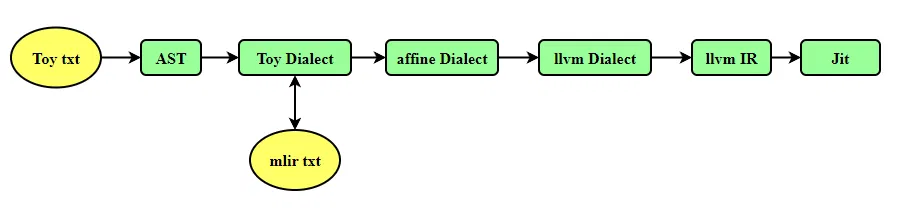
编译过程,下载 github llvm 工程,按照官网编译,值得一提的是,编译整个工具用时太久,我们重点关注 CH* 教程内容,在修改了教程中代码之后,可以只对该部分进行编译:
# 只编译 ch6 | |
ninja -j 4 toyc-ch6 |
编译完成之后,可以执行一些指令进行测试:
# 读取 mlir 到 llvm dialect | |
/your/path/llvm-project/build/bin/toyc-ch6 /your/path/llvm-project/mlir/test/Examples/Toy/Ch5/affine-lowering.mlir -emit=mlir-llvm | |
# 读取 mlir 到 可执行文件 | |
/your/path/llvm-project/build/bin/toyc-ch6 /your/path/llvm-project/mlir/test/Examples/Toy/Ch5/affine-lowering.mlir -emit=jit | |
# 读取 toy 到 toy dialect | |
/your/path/llvm-project/build/bin/toyc-ch6 /your/path/llvm-project/mlir/test/Examples/Toy/Ch6/codegen.toy -emit=mlir | |
# 读取 toy 到 toy dialect opt | |
/your/path/llvm-project/build/bin/toyc-ch6 /your/path/llvm-project/mlir/test/Examples/Toy/Ch6/codegen.toy -emit=mlir -opt | |
# 读取 toy 到 affine dialect | |
/hyour/path/llvm-project/build/bin/toyc-ch6 /your/path/llvm-project/mlir/test/Examples/Toy/Ch6/codegen.toy -emit=mlir-affine | |
# 读取 toy 到 llvm dialect | |
/your/path/llvm-project/build/bin/toyc-ch6 /your/path/llvm-project/mlir/test/Examples/Toy/Ch6/codegen.toy -emit=mlir-llvm |
# Toy Dialect 到 Affine Dialect
前篇博客已经讲解了 toy 语言转换到自定义的 toy dialect 的过程。本篇博客则简单介绍一下后续过程。
主函数调用的 loadAndProcessMLIR 函数完成的,而这个函数里面调用一系列 Pass 实现 dialect 的优化和转换。代码中做了简单的注释。
static int loadAndProcessMLIR(mlir::MLIRContext &context, | |
mlir::OwningOpRef<mlir::ModuleOp> &module) { | |
if (int error = loadMLIR(context, module)) | |
return error; | |
mlir::PassManager pm(module.get()->getName()); | |
// Apply any generic pass manager command line options and run the pipeline. | |
if (mlir::failed(mlir::applyPassManagerCLOptions(pm))) | |
return 4; | |
// Check to see what granularity of MLIR we are compiling to. | |
bool isLoweringToAffine = emitAction >= Action::DumpMLIRAffine; | |
bool isLoweringToLLVM = emitAction >= Action::DumpMLIRLLVM; | |
if (enableOpt || isLoweringToAffine) { // 包含一些优化 pass,降级到 affine 也是必要的 | |
// Inline all functions into main and then delete them. | |
pm.addPass(mlir::createInlinerPass()); | |
// 将所有函数进行 inline 操作,降低后续优化的复杂性 | |
// Now that there is only one function, we can infer the shapes of each of | |
// the operations. | |
mlir::OpPassManager &optPM = pm.nest<mlir::toy::FuncOp>(); | |
// 优化 pass 容器 | |
optPM.addPass(mlir::toy::createShapeInferencePass()); | |
// 自定义 Pass 用于推理 shape,包含 OPS 生成默认 + 自定义的 shape 推理 | |
optPM.addPass(mlir::createCanonicalizerPass()); // [规范化 IR:消除冗余操作、简化常量表达式、应用简单的重写规则] | |
optPM.addPass(mlir::createCSEPass()); // 死代码消除 pass | |
} | |
if (isLoweringToAffine) { // toy dialect -> affine dialect | |
// Partially lower the toy dialect. | |
pm.addPass(mlir::toy::createLowerToAffinePass()); | |
// 自定义降级 pass | |
// Add a few cleanups post lowering. | |
mlir::OpPassManager &optPM = pm.nest<mlir::func::FuncOp>(); | |
optPM.addPass(mlir::createCanonicalizerPass()); | |
optPM.addPass(mlir::createCSEPass()); | |
// Add optimizations if enabled. | |
if (enableOpt) { | |
optPM.addPass(mlir::affine::createLoopFusionPass()); | |
optPM.addPass(mlir::affine::createAffineScalarReplacementPass()); | |
} | |
} | |
if (isLoweringToLLVM) { // affine dialect -> llvm dialect | |
// Finish lowering the toy IR to the LLVM dialect. | |
pm.addPass(mlir::toy::createLowerToLLVMPass()); | |
// 降级 pass | |
// This is necessary to have line tables emitted and basic | |
// debugger working. In the future we will add proper debug information | |
// emission directly from our frontend. | |
pm.addPass(mlir::LLVM::createDIScopeForLLVMFuncOpPass()); | |
} | |
if (mlir::failed(pm.run(*module))) | |
// 执行 pass | |
return 4; | |
return 0; | |
} |
# High-level 语言特性分析和转换 C++ style
本节内容来自于 教程 Chapter 3: High-level Language-Specific Analysis and Transformation,主要讲解在高层级方言 toy dialect ,如果做 pattern 匹配和重写,用的例子是去除连续的 transpose 操作(连续的两个转置 transpose 可以消除 transpose(transpose(X)) -> X )。
def transpose_transpose(x) { // 双重转置 应当消除这种无意义的操作 | |
return transpose(transpose(x)); | |
} |
上述 toy 代码会得到对应的 toy dialect :
toy.func @transpose_transpose(%arg0: tensor<*xf64>) -> tensor<*xf64> { | |
%0 = toy.transpose(%arg0 : tensor<*xf64>) to tensor<*xf64> | |
%1 = toy.transpose(%0 : tensor<*xf64>) to tensor<*xf64> | |
toy.return %1 : tensor<*xf64> | |
} |
从高层级方言进行优化是比较方便的,一旦降级到低层级方言,再进行优化就变得非常困难,例如,当降级到如下层级的时候,再进行优化将非常困难:
#define N 100 | |
#define M 100 | |
// 当前状态 匹配 将非常困难 | |
void sink(void *); | |
void double_transpose(int A[N][M]) { | |
int B[M][N]; | |
for(int i = 0; i < N; ++i) { | |
for(int j = 0; j < M; ++j) { | |
B[j][i] = A[i][j]; | |
} | |
} | |
for(int i = 0; i < N; ++i) { | |
for(int j = 0; j < M; ++j) { | |
A[i][j] = B[j][i]; | |
} | |
} | |
sink(A); | |
} |
教程将一个自定义的 RewritePattern 注册到 MLIR 的 CanonicalizerPass 中,来实现双转置的匹配和重写。前面的代码中提到过,该 pass 用于 [规范化 IR:消除冗余操作、简化常量表达式、应用简单的重写规则]。
在 ToyCombine.cpp 源码中能够找到对应的自定义 RewritePattern 。
/// Fold transpose(transpose(x)) -> x | |
struct SimplifyRedundantTranspose : public mlir::OpRewritePattern<TransposeOp> { // 创建一个优化规则, 其继承一个模板类,专门用于匹配和重写 TransposeOp 操作 | |
/// We register this pattern to match every toy.transpose in the IR. | |
/// The "benefit" is used by the framework to order the patterns and process | |
/// them in order of profitability. | |
SimplifyRedundantTranspose(mlir::MLIRContext *context) | |
: OpRewritePattern<TransposeOp>(context, /*benefit=*/1) {} | |
/// This method is attempting to match a pattern and rewrite it. The rewriter | |
/// argument is the orchestrator of the sequence of rewrites. It is expected | |
/// to interact with it to perform any changes to the IR from here. | |
llvm::LogicalResult matchAndRewrite(TransposeOp op, // 核心方法 matchAndRewrite | |
mlir::PatternRewriter &rewriter) const override { | |
// Look through the input of the current transpose. | |
mlir::Value transposeInput = op.getOperand(); // 1. 获取当前转置的输入 | |
TransposeOp transposeInputOp = transposeInput.getDefiningOp<TransposeOp>(); // 2. 尝试查看这个输入是否由另一个转置定义 | |
// Input defined by another transpose? If not, no match. | |
if (!transposeInputOp) // 3. 如果不是,匹配失败 | |
return failure(); | |
// Otherwise, we have a redundant transpose. Use the rewriter. | |
rewriter.replaceOp(op, {transposeInputOp.getOperand()}); // 4. 如果是,替换当前转置为它的输入 | |
return success(); | |
} | |
}; |
matchAndRewrite 是该 RewritePattern 的核心方法,当 MLIR 框架会在遍历 toy dialect 时,对每个 TransposeOp 调用这个方法。核心思路很简单,即匹配到一个 TransposeOp 的时候,会检查前一个节点是否也是 TransposeOp,不是的话匹配失败,是的话怎直接去掉两个 Transpose 操作。
CanonicalizerPass 以贪婪的、迭代的方式应用由操作定义的转换。为了保证 CanonicalizerPass 能够使用到该 pattern ,在 Ops.td 文件定义 Transpose 操作的时候,能够找到 let hasCanonicalizer = 1; 字段,以及需要通过 Canonicalization framework 注册这个转换 pattern:
// Register our patterns for rewrite by the Canonicalization framework. | |
void TransposeOp::getCanonicalizationPatterns( | |
RewritePatternSet &results, MLIRContext *context) { | |
results.add<SimplifyRedundantTranspose>(context); | |
} |
# High-level 语言特性分析和转换 Declarative style
以上是一种 C++ 的方式实现匹配重写,MLIR 还提供了声明的方式,其提供了一套 rprovides a table-based syntax for pattern-match and rewrite rules,从 td 文件中声明匹配和重写规则。
以下是 toy 教程中针对 ReshapeOp 操作定义的声明式重写规则,其位于 ToyCombine.td 文件中。该文件主要定义了三个针对 toy.reshape 操作的优化,同上述 C++ 风格的匹配重写函数一样,这些优化在 CanonicalizerPass 运行时会被自动调用。
//===- ToyCombine.td - Pattern Match Optimizations for Toy -*- tablegen -*-===// | |
// | |
// Part of the LLVM Project, under the Apache License v2.0 with LLVM Exceptions. | |
// See https://llvm.org/LICENSE.txt for license information. | |
// SPDX-License-Identifier: Apache-2.0 WITH LLVM-exception | |
// | |
//===----------------------------------------------------------------------===// | |
// | |
// Defines language-specific pattern match optimizations for Toy using | |
// Declarative Rewrite Rules (DRR) specified using TableGen records. | |
// | |
//===----------------------------------------------------------------------===// | |
#ifndef TOY_COMBINE | |
#define TOY_COMBINE | |
include "mlir/IR/PatternBase.td" | |
include "toy/Ops.td" | |
/// Note: The DRR definition used for defining patterns is shown below: | |
/// | |
/// class Pattern< | |
/// dag sourcePattern, list<dag> resultPatterns, | |
/// list<dag> additionalConstraints = [], | |
// list<dag> supplementalPatterns = [], | |
/// dag benefitsAdded = (addBenefit 0) | |
/// >; | |
//===----------------------------------------------------------------------===// | |
// Basic Pattern-Match and Rewrite | |
//===----------------------------------------------------------------------===// | |
// Reshape(Reshape(x)) = Reshape(x) | |
def ReshapeReshapeOptPattern : Pat<(ReshapeOp(ReshapeOp $arg)), | |
(ReshapeOp $arg)>; | |
//===----------------------------------------------------------------------===// | |
// Pattern-Match and Rewrite using Native Code Call | |
//===----------------------------------------------------------------------===// | |
// Native Code Calls may be used for more complex transformations using inline | |
// C++ and C++ helper functions. | |
// Reshape(Constant(x)) = x' | |
def ReshapeConstant : | |
NativeCodeCall<"$0.reshape(::llvm::cast<ShapedType>($1.getType()))">; | |
def FoldConstantReshapeOptPattern : Pat< | |
(ReshapeOp:$res (ConstantOp $arg)), | |
(ConstantOp (ReshapeConstant $arg, $res))>; | |
//===----------------------------------------------------------------------===// | |
// Pattern-Match and Rewrite with Constraints | |
//===----------------------------------------------------------------------===// | |
// DRR allows for constraint checking when the transformation is conditional | |
// on operand properties. | |
// Reshape(x) = x, where input and output shapes are identical | |
def TypesAreIdentical : Constraint<CPred<"$0.getType() == $1.getType()">>; | |
def RedundantReshapeOptPattern : Pat< | |
(ReshapeOp:$res $arg), (replaceWithValue $arg), | |
[(TypesAreIdentical $res, $arg)]>; | |
#endif // TOY_COMBINE |
我们来分别看看这三个重写规则:
1. 消除连续的 Reshape
// Reshape(Reshape(x)) = Reshape(x) | |
def ReshapeReshapeOptPattern : Pat<(ReshapeOp(ReshapeOp $arg)), | |
(ReshapeOp $arg)>; // 将外层输入替换为内层 |
其实当有两个连续的 Reshape 存在的时候,内层的 reshape 就没有作用了,所以将源模式 (ReshapeOp(ReshapeOp $arg)) 替换为新模式 (ReshapeOp $arg) ,这样就完成了 连续 reshape 的替换。而且保留的 reshape 参数是外层的 reshape 参数,这是符合逻辑的。
2. 常量折叠 + reshape
// Reshape(Constant(x)) = x' | |
def ReshapeConstant : // NativeCodeCall 调用一段手写的 C++ 代码片段 | |
NativeCodeCall<"$0.reshape(::llvm::cast<ShapedType>($1.getType()))">; | |
def FoldConstantReshapeOptPattern : Pat< | |
(ReshapeOp:$res (ConstantOp $arg)), // 匹配的是 Reshape (Constant (x)) 结构 | |
(ConstantOp (ReshapeConstant $arg, $res))>; |
匹配的是 Reshape (Constant (x)) 结构,匹配之后变成单个 ConstantOp。
NativeCodeCall 调用一段手写 C++ 代码片段,将常量 $arg 重塑为 $res 所要求的形状。
举个例子,假设优化前的源代码如下:
// 1. 常量定义 | |
%0 = toy.constant dense<[1.0, 2.0, 3.0, 4.0, 5.0, 6.0]> : tensor<6xf64> | |
// 2. Reshape 操作 | |
%1 = toy.reshape(%0) : tensor<6xf64> -> tensor<2x3xf64> |
之后 CanonicalizerPass 会匹配 reshape + Constant 的结构,然后调用写好的重写规则,将其变成新的:
// 原来的 %0 不变(但可能变为死代码,被其他优化 pass 清除) | |
%0 = toy.constant dense<[1.0, 2.0, 3.0, 4.0, 5.0, 6.0]> : tensor<6xf64> | |
// 新的常量 | |
%1 = toy.constant dense<[[1.0, 2.0, 3.0], [4.0, 5.0, 6.0]]> : tensor<2x3xf64> |
3. 消除多余的 reshape
当输入和 reshape 的输出,他们的数据类型相同,即维度 shape 相同的时候,去掉 reshape 算子。
// Reshape(x) = x, where input and output shapes are identical | |
def TypesAreIdentical : Constraint<CPred<"$0.getType() == $1.getType()">>; | |
def RedundantReshapeOptPattern : Pat< | |
(ReshapeOp:$res $arg), (replaceWithValue $arg), | |
[(TypesAreIdentical $res, $arg)]>; |
举了例子:
// 匹配前 | |
%0 = toy.reshape(%arg0) : tensor<2x3xf64> -> tensor<2x3xf64> | |
// 匹配后 | |
// %0 被完全移除,所有使用 %0 的地方都被替换为 % arg0 |
多 td 文件中声明匹配和重写规则的细节,可以参考 Table-driven Declarative Rewrite Rule (DRR)
上述就是两种匹配重写的方式:声明式和 C++ 手写式,相比较而言,声明式更简洁方便,代码量少,但是调试难度高,不够灵活,适用于简单的匹配场景,而 C++ 方式更灵活,灵活性高,能实现复杂逻辑,但是写起来更复杂。
# 后记
I have seen things you people wouldn't believe. | |
Attack ships on fire off the shoulder of Orion. | |
I have watched C-beams glitter in the dark near the Tannhauser Gate. | |
All those ... moments will be lost in time, like tears ... in rain. | |
Time to die ... | |
《银翼杀手》 |
本博客目前以及可预期的将来都不会支持评论功能。各位大侠如若有指教和问题,可以在我的 github 项目 或随便一个项目下提出 issue,并指明哪一篇博客,看到一定及时回复!