# 前言
现在开启 MLIR 学习系列。本篇是跟着 Toy 语言学习 MLIR 的第四篇,主要介绍高层级 toy dialect 降级到低层方言的过程,前述内容请参考【MLIR】跟着 Toy 语言学习 MLIR【1】Toy 语言和 Toy Dialect,【MLIR】跟着 Toy 语言学习 MLIR【2】pattern 匹配和重写,【MLIR】跟着 Toy 语言学习 MLIR【3】通过接口实现通用转换。
学习 MLIR 最好的方式还是照着官方教程来,但是只看 MLIR 官网教程,Ch1 到 Ch6,没有基础的话又让人学着有点吃力。现发现好多细节,不看教程认识不到,所以当前内容跟随官网教程。
相关链接: LLVM Project ,MLIR 官方文档,MLIR 官网教程,【编译器】使用 llvm 编译自定义语言【1】构建 AST ,【MLIR】跟着 Toy 语言学习 MLIR【2】pattern 匹配和重写,【MLIR】跟着 Toy 语言学习 MLIR【3】通过接口实现通用转换。
作为初学者,错误在所难免,还望不吝赐教。
# 基本简介
官网 Toy 教程 展示了如何将自定义语言 Toy 借助 MLIR 一步步编译为可执行机器码的过程。Toy 是一种简单的自定义语言,为了简便,其所有数据类型定义为 fp64 类型的 Tensor,支持 +/* 操作和 transpose 等有限的操作。
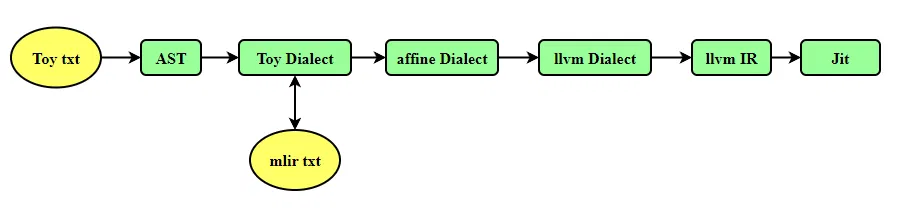
以下是整个编译降级的过程:
Toy txt -> Toy AST -> Toy Dialect -> Affine Dialect -> llvm Dialect -> llvm IR -> 机器码(通过 JIT 编译)
# 本章内容
前述章节中我们已经将 toy 语言转换成 toy dialect,甚至还添加了 Operation 匹配重写、inline 和 inferShape 接口等,对 toy dialect 进行优化,现在我们迫切地将 toy dialect 转换成实际的代码,最终转换成 llvm,让其投入使用。但本章不会直接将其转换为 llvm,而是将其进行逐步降级 (渐进式降级),这样我们就可以重用 MLIR 提供的针对中间层级方言的优化技术。
Affine 调方言专为程序中计算密集的部分设计,其功能有限:例如,它不支持表示 Toy 中的 print 内置函数,也不应支持!因此我们可以将 toy dialect 密集计算部分降级到 affine dialect 并进行优化,而 print 内置函数保留原来的 toy dialect。
# 方言转换
MLIR 拥有多种不同的方言,因此有必要建立一个统一的框架来实现它们之间的转换。这时,DialectConversion 框架就派上了用场。DialectConversion 框架提供了一个标准化的、可扩展的 “翻译工具箱”,用于将一个方言(Dialect)的操作降级(Lowering)或转换到另一个方言。
使用这个框架需要提供两个必要内容和一个可选内容。
Conversion Target 转换目标:ConversionTarget 定义了 “什么是合法的”,什么是非法的,然后必须要将非法操作替换为合法操作。
Rewrite Patterns 一组翻译规则 :RewritePattern 定义了具体的转换逻辑。比如它告诉框架:“当你遇到一个 toy.add 操作时,请按照以下方式将其替换为一组 arith 和 affine 操作。”
Type Converter 跨方言的 “类型翻译” (可选): 当转换涉及类型变化时(例如从 tensor<...> 到 memref<...>),就需要 TypeConverter 。
# Conversion Target
我们希望将计算密集型的 Toy 操作转换为 Affine、Arith、Func 和 MemRef 方言的组合操作,以便进一步优化。所以首先定义转换目标:
void ToyToAffineLoweringPass::runOnOperation() { | |
// The first thing to define is the conversion target. This will define the | |
// final target for this lowering. | |
mlir::ConversionTarget target(getContext()); | |
// We define the specific operations, or dialects, that are legal targets for | |
// this lowering. In our case, we are lowering to a combination of the | |
// `Affine`, `Arith`, `Func`, and `MemRef` dialects. | |
target.addLegalDialect<affine::AffineDialect, arith::ArithDialect, | |
func::FuncDialect, memref::MemRefDialect>(); // 将目标方言设置为合法 | |
// We also define the Toy dialect as Illegal so that the conversion will fail | |
// if any of these operations are *not* converted. Given that we actually want | |
// a partial lowering, we explicitly mark the Toy operations that don't want | |
// to lower, `toy.print`, as *legal*. `toy.print` will still need its operands | |
// to be updated though (as we convert from TensorType to MemRefType), so we | |
// only treat it as `legal` if its operands are legal. | |
target.addIllegalDialect<ToyDialect>(); // 将 toy dialect 设置为非法 | |
target.addDynamicallyLegalOp<toy::PrintOp>([](toy::PrintOp op) { // 将 toy 中的 print 设置为合法 | |
return llvm::none_of(op->getOperandTypes(), llvm::IsaPred<TensorType>); | |
}); | |
... | |
} |
我们通过 Pass 来完成方言转换操作, ToyToAffineLoweringPass 是一个 Pass,它重写了 runOnOperation 方法。在前述章节中我们提到过 Pass 需要重写的核心方法就是 runOnOperation 。
在这个方法中指明了哪些方言合法,哪些方言非法,并特别指定了 toy.print 这个操作合法,因为我们没法将其转换到 Affine。
# Conversion Patterns
前述章节方言内的优化(如 transpose (transpose (x)) -> x)的时候,我们使用过 RewritePattern ,它是方言内部的匹配和重写,现在我们需要跨方言的转换 ConversionPattern 。
和 RewritePattern 不同的是, ConversionPattern 接收一个额外的参数(OpAdaptor),该参数包含已重新映射或替换的操作数。
意思就是说,我们将操作(例如 toy.transpose)降级到 Affine 之后,需要将对应的操作数也从 TensorType 降级到 MemRefType 类型,因为 affine 方言的所有内存操作(如 affine.load、affine.store)都要求操作数是 memref 类型。而 OpAdaptor 就是用来提供操作数的类型映射。
/// Lower the `toy.transpose` operation to an affine loop nest. | |
struct TransposeOpLowering : public OpConversionPattern<toy::TransposeOp> { // 这次继承的是 OpConversionPattern | |
using OpConversionPattern<toy::TransposeOp>::OpConversionPattern; | |
LogicalResult matchAndRewrite(toy::TransposeOp op, OpAdaptor adaptor, | |
ConversionPatternRewriter &rewriter) const final { | |
auto loc = op->getLoc(); | |
lowerOpToLoops(op, rewriter, | |
[&](OpBuilder &builder, ValueRange loopIvs) { | |
Value input = adaptor.getInput(); | |
// Transpose the elements by generating a load from the | |
// reverse indices. | |
SmallVector<Value, 2> reverseIvs(llvm::reverse(loopIvs)); | |
return affine::AffineLoadOp::create(builder, loc, input, | |
reverseIvs); | |
}); | |
return success(); | |
} | |
}; |
这个模式匹配重写继承的是 OpConversionPattern ,而非之前 transpose(transpose(x)) -> x 时的 OpRewritePattern ,同样是重写 matchAndRewrite 函数,但它多了 适配器 OpAdaptor 。而且我们发现,这个 OpAdaptor 是作为参数传入的,并不需要我们手动实现,实际上, DialectConversion 框架在调用你的 matchAndRewrite 方法时,会自动创建一个 OpAdaptor 实例,并传递当前操作的实际操作数。
接下来就是将这些操作转换匹配全部放在刚才的 Pass 函数里面:
void ToyToAffineLoweringPass::runOnOperation() { | |
... | |
// Now that the conversion target has been defined, we just need to provide | |
// the set of patterns that will lower the Toy operations. | |
mlir::RewritePatternSet patterns(&getContext()); | |
patterns.add<..., TransposeOpLowering>(&getContext()); // 将 操作转换 Pattern 添加进来 | |
... |
# Partial Lowering
部分降级。 DialectConversion 框架提供了多种不同的降级模式,这里选择部分降级,因为还有部分(toy.print)不会降级:
void ToyToAffineLoweringPass::runOnOperation() { | |
... | |
// With the target and rewrite patterns defined, we can now attempt the | |
// conversion. The conversion will signal failure if any of our *illegal* | |
// operations were not converted successfully. | |
if (mlir::failed(mlir::applyPartialConversion(getOperation(), target, patterns))) | |
signalPassFailure(); | |
} |
一个 toy dialect 降级的例子,降级之前:
toy.func @main() { | |
%0 = toy.constant dense<[[1.000000e+00, 2.000000e+00, 3.000000e+00], [4.000000e+00, 5.000000e+00, 6.000000e+00]]> : tensor<2x3xf64> | |
%2 = toy.transpose(%0 : tensor<2x3xf64>) to tensor<3x2xf64> | |
%3 = toy.mul %2, %2 : tensor<3x2xf64> | |
toy.print %3 : tensor<3x2xf64> | |
toy.return | |
} |
降级之后:
func.func @main() { | |
%cst = arith.constant 1.000000e+00 : f64 | |
%cst_0 = arith.constant 2.000000e+00 : f64 | |
%cst_1 = arith.constant 3.000000e+00 : f64 | |
%cst_2 = arith.constant 4.000000e+00 : f64 | |
%cst_3 = arith.constant 5.000000e+00 : f64 | |
%cst_4 = arith.constant 6.000000e+00 : f64 | |
// Allocating buffers for the inputs and outputs. | |
%0 = memref.alloc() : memref<3x2xf64> | |
%1 = memref.alloc() : memref<3x2xf64> | |
%2 = memref.alloc() : memref<2x3xf64> | |
// Initialize the input buffer with the constant values. | |
affine.store %cst, %2[0, 0] : memref<2x3xf64> | |
affine.store %cst_0, %2[0, 1] : memref<2x3xf64> | |
affine.store %cst_1, %2[0, 2] : memref<2x3xf64> | |
affine.store %cst_2, %2[1, 0] : memref<2x3xf64> | |
affine.store %cst_3, %2[1, 1] : memref<2x3xf64> | |
affine.store %cst_4, %2[1, 2] : memref<2x3xf64> | |
// Load the transpose value from the input buffer and store it into the | |
// next input buffer. | |
affine.for %arg0 = 0 to 3 { | |
affine.for %arg1 = 0 to 2 { | |
%3 = affine.load %2[%arg1, %arg0] : memref<2x3xf64> | |
affine.store %3, %1[%arg0, %arg1] : memref<3x2xf64> | |
} | |
} | |
// Multiply and store into the output buffer. | |
affine.for %arg0 = 0 to 3 { | |
affine.for %arg1 = 0 to 2 { | |
%3 = affine.load %1[%arg0, %arg1] : memref<3x2xf64> | |
%4 = affine.load %1[%arg0, %arg1] : memref<3x2xf64> | |
%5 = arith.mulf %3, %4 : f64 | |
affine.store %5, %0[%arg0, %arg1] : memref<3x2xf64> | |
} | |
} | |
// Print the value held by the buffer. | |
toy.print %0 : memref<3x2xf64> | |
memref.dealloc %2 : memref<2x3xf64> | |
memref.dealloc %1 : memref<3x2xf64> | |
memref.dealloc %0 : memref<3x2xf64> | |
return | |
} |
# 部分降级的问题
当一个操作(如 toy.print)没有被完全降级时,如何让它同时支持高层的 tensor 和低层的 memref?
在降级过程中,大部分 toy 操作(如 add、transpose)被转换成了 affine 循环和 memref。但 toy.print 没有被降级,它仍然是一个 toy 方言的操作,此时它的输入出现了矛盾:toy.print 的定义只接受 tensor,但降级后的数据是 memref。
教程提出了三种方案:
1. 从 memref 生成 tensor(隐式复制)
// 降级后的 IR(方案 1) | |
%memref = ... : memref<2x3xf64> // 实际数据在 memref 中 | |
%tensor = "toy.materialize"(%memref) : memref<2x3xf64> -> tensor<2x3xf64> // 隐式复制 | |
toy.print %tensor : tensor<2x3xf64> // 打印张量 | |
// 优点: | |
//toy.print 定义不用改。 | |
// 缺点:增加了一次隐式复制,可能隐藏优化机会。 |
2. 创建 toy.print_memref(新增操作)
// 降级后的 IR(方案 2) | |
%memref = ... : memref<2x3xf64> | |
toy.print_memref %memref : memref<2x3xf64> // 新的打印操作 |
3. 让 toy.print 同时支持 tensor 和 memref
// 降级后的 IR(方案 3) | |
%memref = ... : memref<2x3xf64> | |
toy.print %memref : memref<2x3xf64> // 直接打印 memref | |
// 优点:简单,没有隐式复制,也没有重复定义。 | |
// 缺点:toy.print 现在混合了两种抽象层级(tensor 和 memref)。 |
教程选择了第三种方案,即定义 Print 操作的时候,让其支持两种类型的操作数。
def PrintOp : Toy_Op<"print"> { | |
... | |
// The print operation takes an input tensor to print. | |
// We also allow a F64MemRef to enable interop during partial lowering. | |
let arguments = (ins AnyTypeOf<[F64Tensor, F64MemRef]>:$input); | |
} |
AnyTypeOf<[F64Tensor, F64MemRef]> 表示 PrintOp 的输入可以是 F64Tensor 或 F64MemRef 。
这样,toy.print 在降级前可以接受 tensor,在降级后可以接受 memref,不需要任何额外操作。
# Affine 优化
上述已经将 toy dialect 降级到 Affine dialect,它是正确的,但在效率方面仍有很大提升空间。例如,toy.mul 的降级产生了一些冗余的加载操作。而 MLIR 为已有的 Affine dialect 提供了好用的优化 Pass。我们只需要将 LoopFusion 和 AffineScalarReplacement 通过 passes 添加到流水线后,就能对当前的方言进行优化:
if (isLoweringToAffine) { | |
// Partially lower the toy dialect. | |
pm.addPass(mlir::toy::createLowerToAffinePass()); | |
// Add a few cleanups post lowering. | |
mlir::OpPassManager &optPM = pm.nest<mlir::func::FuncOp>(); | |
optPM.addPass(mlir::createCanonicalizerPass()); | |
optPM.addPass(mlir::createCSEPass()); | |
// Add optimizations if enabled. | |
if (enableOpt) { | |
optPM.addPass(mlir::affine::createLoopFusionPass()); // 添加循环融合 pass | |
optPM.addPass(mlir::affine::createAffineScalarReplacementPass()); | |
// 添加标量替换 pass | |
} | |
} |
LoopFusion 是循环融合 pass,能够将相邻的、有相同循环边界的循环融合为一个循环,减少循环开销,提升数据局部性。
AffineScalarReplacement 检测临时分配的 memref 是否可以被标量(寄存器)替换,从而减少内存访问。
func.func @main() { | |
%cst = arith.constant 1.000000e+00 : f64 | |
%cst_0 = arith.constant 2.000000e+00 : f64 | |
%cst_1 = arith.constant 3.000000e+00 : f64 | |
%cst_2 = arith.constant 4.000000e+00 : f64 | |
%cst_3 = arith.constant 5.000000e+00 : f64 | |
%cst_4 = arith.constant 6.000000e+00 : f64 | |
// Allocating buffers for the inputs and outputs. | |
%0 = memref.alloc() : memref<3x2xf64> | |
%1 = memref.alloc() : memref<2x3xf64> | |
// Initialize the input buffer with the constant values. | |
affine.store %cst, %1[0, 0] : memref<2x3xf64> | |
affine.store %cst_0, %1[0, 1] : memref<2x3xf64> | |
affine.store %cst_1, %1[0, 2] : memref<2x3xf64> | |
affine.store %cst_2, %1[1, 0] : memref<2x3xf64> | |
affine.store %cst_3, %1[1, 1] : memref<2x3xf64> | |
affine.store %cst_4, %1[1, 2] : memref<2x3xf64> | |
affine.for %arg0 = 0 to 3 { | |
affine.for %arg1 = 0 to 2 { | |
// Load the transpose value from the input buffer. | |
%2 = affine.load %1[%arg1, %arg0] : memref<2x3xf64> | |
// Multiply and store into the output buffer. | |
%3 = arith.mulf %2, %2 : f64 | |
affine.store %3, %0[%arg0, %arg1] : memref<3x2xf64> | |
} | |
} | |
// Print the value held by the buffer. | |
toy.print %0 : memref<3x2xf64> | |
memref.dealloc %1 : memref<2x3xf64> | |
memref.dealloc %0 : memref<3x2xf64> | |
return | |
} |
可以通过以下指令,以及是否添加 -opt 来检查优化前后的区别。
toyc-ch5 test/Examples/Toy/Ch5/affine-lowering.mlir -emit=mlir-affine |
# 后记
I know someone in the world is waiting for me, although I've no idea of who he is. But I feel happy every day for this. | |
- 《返老还童》 |
本博客目前以及可预期的将来都不会支持评论功能。各位大侠如若有指教和问题,可以在我的 github 项目 或随便一个项目下提出 issue,并指明哪一篇博客,看到一定及时回复!