# 前言
现在开启 MLIR 学习系列。本篇是跟着 Toy 语言学习 MLIR 的第六篇,前述章节已经完整介绍了 toy 语言经 MLIR 降级到 llvm ir,并通过 JIT 进行编译执行的过程,本章节是教程中增添复合类型章节。前述内容请参考【MLIR】跟着 Toy 语言学习 MLIR【1】Toy 语言和 Toy Dialect,【MLIR】跟着 Toy 语言学习 MLIR【2】pattern 匹配和重写,【MLIR】跟着 Toy 语言学习 MLIR【3】通过接口实现通用转换。
相关链接: LLVM Project ,MLIR 官方文档,MLIR 官网教程,【编译器】使用 llvm 编译自定义语言【1】构建 AST ,【MLIR】跟着 Toy 语言学习 MLIR【2】pattern 匹配和重写,【MLIR】跟着 Toy 语言学习 MLIR【3】通过接口实现通用转换。
作为初学者,错误在所难免,还望不吝赐教。
# 基本简介
官网 Toy 教程 展示了如何将自定义语言 Toy 借助 MLIR 一步步编译为可执行机器码的过程。Toy 是一种简单的自定义语言,为了简便,其所有数据类型定义为 fp64 类型的 Tensor,支持 +/* 操作和 transpose 等有限的操作。
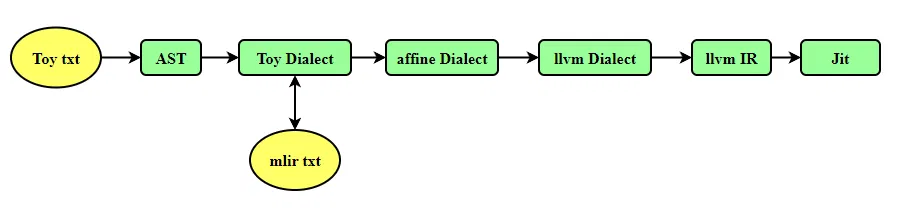
以下是整个编译降级的过程:
Toy txt -> Toy AST -> Toy Dialect -> Affine Dialect -> llvm Dialect -> llvm IR -> 机器码(通过 JIT 编译)
# 在 Toy 中定义 Struct 类型
Struct 在 Toy 语言中的定义非常简单,和 C++ 语言中的定义与初始化差不多:
# A struct is defined by using the `struct` keyword followed by a name. | |
struct MyStruct { // 这里是定义 | |
# Inside of the struct is a list of variable declarations without initializers | |
# or shapes, which may also be other previously defined structs. | |
var a; | |
var b; | |
} |
这是给的 toy 语言例子,包含了 struct 的定义初始化和调用。
struct Struct { | |
var a; | |
var b; | |
} | |
# User defined generic function may operate on struct types as well. | |
def multiply_transpose(Struct value) { | |
# We can access the elements of a struct via the '.' operator. | |
return transpose(value.a) * transpose(value.b); | |
} | |
def main() { | |
# We initialize struct values using a composite initializer. | |
Struct value = {[[1, 2, 3], [4, 5, 6]], [[1, 2, 3], [4, 5, 6]]}; | |
# We pass these arguments to functions like we do with variables. | |
var c = multiply_transpose(value); | |
print(c); | |
} |
# 在 MLIR 中定义 struct
在 MLIR 中,我们也需要为结构体类型定义一种表示方式。MLIR 本身没有提供完全满足我们需求的类型,因此我们需要自行定义。
可以简单地将结构体定义为一组元素类型的无名容器。
# 定义 Type Class
当我们需要定义一个新的复杂类型(如 struct)时,需要提供自定义的存储类(Storage Class)
MLIR 中的类型 Type 是 “值类型”,Type 对象本身是一个轻量级的包装器,它不存储实际的数据,而是指向一个内部的存储对象。
// MLIR 中的 Type 类(简化) | |
class Type { | |
TypeStorage *impl; // 指向内部存储 | |
//... 方法 ... | |
}; |
举例来说,String 在 Java 中也是值类型, 在 Java 中,String 对象是不可变的,多个 String 变量可以共享同一个底层字符数组。
Type 类本身只是 TypeStorage 对象的一个简单包装器,而这个 TypeStorage 对象是在 MLIRContext 中被唯一化的。“唯一化” 意味着:同一种类型在同一个上下文中只会有一个存储实例。这种设计,节省内存:同一种类型只存一份,避免重复;快速比较:比较两个类型只需要比较指针地址,而不是逐字段比较。
Defining the Storage Class
什么时候需要定义存储类?当需要定义一个包含参数化数据的新类型(如 struct 类型,需要存储元素类型列表)时,你需要提供一个派生的存储类。而那些没有额外数据的单例类型(如 index 类型,i32 类型,f64 类型等)则不需要自定义存储类,直接使用默认的 TypeStorage。
类型存储对象包含构建和唯一化类型实例所需的所有数据。派生的存储类必须继承自基础的 mlir::TypeStorage,并提供一组别名和钩子,供 MLIRContext 用于唯一化处理。以下是结构体类型 struct 的存储实例定义,可以在 Dialect.cpp 中找到:
/// This class represents the internal storage of the Toy `StructType`. | |
struct StructTypeStorage : public mlir::TypeStorage { // 继承 mlir:: TypeStorage | |
/// The `KeyTy` is a required type that provides an interface for the storage | |
/// instance. This type will be used when uniquing an instance of the type | |
/// storage. For our struct type, we will unique each instance structurally on | |
/// the elements that it contains. | |
using 核心概念 = llvm::ArrayRef<mlir::Type>; // 定义键类型 用于唯一化存储实例 | |
/// A constructor for the type storage instance. | |
StructTypeStorage(llvm::ArrayRef<mlir::Type> elementTypes) // 构造函数 | |
: elementTypes(elementTypes) {} | |
/// Define the comparison function for the key type with the current storage | |
/// instance. This is used when constructing a new instance to ensure that we | |
/// haven't already uniqued an instance of the given key. | |
bool operator==(const KeyTy &key) const { return key == elementTypes; } // 相等性比较,用于比较 当前存储实例 和 给定的键 是否相等 | |
/// Define a hash function for the key type. This is used when uniquing | |
/// instances of the storage. | |
/// Note: This method isn't necessary as both llvm::ArrayRef and mlir::Type | |
/// have hash functions available, so we could just omit this entirely. | |
static llvm::hash_code hashKey(const KeyTy &key) { // 哈希函数 | |
return llvm::hash_value(key); | |
} | |
/// Define a construction function for the key type from a set of parameters. | |
/// These parameters will be provided when constructing the storage instance | |
/// itself, see the `StructType::get` method further below. | |
/// Note: This method isn't necessary because KeyTy can be directly | |
/// constructed with the given parameters. | |
static KeyTy getKey(llvm::ArrayRef<mlir::Type> elementTypes) { // 键构建函数 | |
return KeyTy(elementTypes); | |
} | |
/// Define a construction method for creating a new instance of this storage. | |
/// This method takes an instance of a storage allocator, and an instance of a | |
/// `KeyTy`. The given allocator must be used for *all* necessary dynamic | |
/// allocations used to create the type storage and its internal. | |
static StructTypeStorage *construct(mlir::TypeStorageAllocator &allocator, // 存储构造函数,MLIR 框架要求提供的一个 “工厂方法” | |
const KeyTy &key) { | |
// Copy the elements from the provided `KeyTy` into the allocator. | |
llvm::ArrayRef<mlir::Type> elementTypes = allocator.copyInto(key); // 数据成员 | |
// Allocate the storage instance and construct it. | |
return new (allocator.allocate<StructTypeStorage>()) | |
StructTypeStorage(elementTypes); | |
} | |
/// The following field contains the element types of the struct. | |
llvm::ArrayRef<mlir::Type> elementTypes; | |
}; |
这个 struct 的存储实例,是为了支持 toy 语言中的 struct 语法。有了它,toy 语言就可以定义各种结构的 struct。
keyTy 是 MLIR 的核心概念,它定义了用于唯一化存储实例(一个存储类型)的键类型。对于 StructType,唯一化的依据是它的元素类型列表,当 MLIRContext 在创建类型时,会检查是否已经存在相同键的存储实例。如果有,直接返回已存在的实例,否则创建新的。
构造函数接收元素类型列表,并将其存储到 elementTypes 成员变量中。元素类型类型列表决定了当前定义的 struct 的唯一性。
相等性比较,看起来好像是比较两个定义实例是否相同的,防止重复定义。
哈希函数:为键计算哈希值,用于在哈希表中快速定位存储实例。
键构建函数 getKey 将键列表构建为 KeyTy ,当然 KeyTy 本身就是键列表。
存储构造函数:MLIR 框架要求提供的一个 “工厂方法”,职责是 “构造存储实例”(Construct a Storage Instance)。
Defining the Type Class
定义类型。
在定义好存储类后,我们可以添加用户可见的 StructType 类的定义。这个类是我们实际进行交互的对象。
/// This class defines the Toy struct type. It represents a collection of | |
/// element types. All derived types in MLIR must inherit from the CRTP class | |
/// 'Type::TypeBase'. It takes as template parameters the concrete type | |
/// (StructType), the base class to use (Type), and the storage class | |
/// (StructTypeStorage). | |
class StructType : public mlir::Type::TypeBase<StructType, mlir::Type, StructTypeStorage> { | |
public: | |
/// Inherit some necessary constructors from 'TypeBase'. | |
using Base::Base; | |
/// Create an instance of a `StructType` with the given element types. There | |
/// *must* be at least one element type. | |
static StructType get(llvm::ArrayRef<mlir::Type> elementTypes) { // 创建 StructType 实例,通过 Base::get, 调用 StructTypeStorage::getKey (elementTypes) | |
assert(!elementTypes.empty() && "expected at least 1 element type"); | |
// Call into a helper 'get' method in 'TypeBase' to get a uniqued instance | |
// of this type. The first parameter is the context to unique in. The | |
// parameters after are forwarded to the storage instance. | |
mlir::MLIRContext *ctx = elementTypes.front().getContext(); | |
return Base::get(ctx, elementTypes); | |
} | |
/// Returns the element types of this struct type. | |
llvm::ArrayRef<mlir::Type> getElementTypes() { // 数据访问方法,返回类型列表 | |
// 'getImpl' returns a pointer to the internal storage instance. | |
return getImpl()->elementTypes; | |
} | |
/// Returns the number of element type held by this struct. | |
size_t getNumElementTypes() { return getElementTypes().size(); } // 返回类型列表大小 | |
}; |
Type 类定义遵循了 MLIR 中 CRTP(奇异递归模板模式,Curiously Recurring Template Pattern) 的设计模式。它帮助实现了一些功能,如唯一化(Uniquing)机制,类型转换(cast、dyn_cast)支持,上下文管理等。
StructType 对象是轻量级的,它们只包含一个指向 StructTypeStorage 的指针。
多个 StructType 对象可以共享同一个 StructTypeStorage 实例(如果它们的 KeyTy 相同)。
然后在 toy dialect 中注册这个自定义类型:
void ToyDialect::initialize() { | |
addTypes<StructType>(); | |
} |
Exposing to ODS
当定义了一个新的类型,我们需要确保 ODS 框架能够 “看得到” 这个新类型,以便在操作定义和方言中的自动生成工具中使用它。以下是一个简单的示例:
// Provide a definition for the Toy StructType for use in ODS. This allows for | |
// using StructType in a similar way to Tensor or MemRef. We use `DialectType` | |
// to demarcate the StructType as belonging to the Toy dialect. | |
def Toy_StructType : | |
DialectType<Toy_Dialect, CPred<"isa<StructType>($_self)">, | |
"Toy struct type">; | |
// Provide a definition of the types that are used within the Toy dialect. | |
def Toy_Type : AnyTypeOf<[F64Tensor, Toy_StructType]>; |
它是如何绑定到 C++ 代码中的自定义类型 StructType 的呢? DialectType<Toy_Dialect, ...> 指明这是一个属于 Toy_Dialect 方言的类型。CPred 是连接 ODS 和 C++ 的 “桥梁”,通过 CPred<"isa<StructType>($_self)"> 这个谓词(Predicate)与 C++ 中的 StructType 类绑定在一起的。 isa<StructType>($_self) 是一个 C++ 表达式,用于检查一个类型是否是 StructType 。
Parsing and Printing
此时,可以在 MLIR 生成和转换过程中使用 StructType,但无法输出或解析 .mlir 文件。为此,我们需要为 StructType 的实例添加解析和打印支持。这可以通过重写 ToyDialect 中的 parseType 和 printType 方法来实现。
class ToyDialect : public mlir::Dialect { | |
public: | |
/// Parse an instance of a type registered to the toy dialect. | |
mlir::Type parseType(mlir::DialectAsmParser &parser) const override; | |
/// Print an instance of a type registered to the toy dialect. | |
void printType(mlir::Type type, | |
mlir::DialectAsmPrinter &printer) const override; | |
}; |
根据 MLIR 语言参考文档所述,方言类型通常表示为:! dialect-namespace <type-data>,在某些情况下可提供更美观的格式。所以教程将 struct 类型的打印定义为如下形式:
struct-type ::= `struct` `<` type (`,` type)* `>` |
那么解析(Parser)就可以定义为:
/// Parse an instance of a type registered to the toy dialect. | |
mlir::Type ToyDialect::parseType(mlir::DialectAsmParser &parser) const { // 解析类 | |
// Parse a struct type in the following form: | |
// struct-type ::= `struct` `<` type (`,` type)* `>` | |
// NOTE: All MLIR parser function return a ParseResult. This is a | |
// specialization of LogicalResult that auto-converts to a `true` boolean | |
// value on failure to allow for chaining, but may be used with explicit | |
// `mlir::failed/mlir::succeeded` as desired. | |
// Parse: `struct` `<` | |
if (parser.parseKeyword("struct") || parser.parseLess()) | |
return Type(); | |
// Parse the element types of the struct. | |
SmallVector<mlir::Type, 1> elementTypes; | |
do { | |
// Parse the current element type. | |
SMLoc typeLoc = parser.getCurrentLocation(); | |
mlir::Type elementType; | |
if (parser.parseType(elementType)) | |
return nullptr; | |
// Check that the type is either a TensorType or another StructType. | |
if (!isa<mlir::TensorType, StructType>(elementType)) { | |
parser.emitError(typeLoc, "element type for a struct must either " | |
"be a TensorType or a StructType, got: ") | |
<< elementType; | |
return Type(); | |
} | |
elementTypes.push_back(elementType); | |
// Parse the optional: `,` | |
} while (succeeded(parser.parseOptionalComma())); | |
// Parse: `>` | |
if (parser.parseGreater()) | |
return Type(); | |
return StructType::get(elementTypes); | |
} |
解析类,帮助从文本中反序列化回内存对象。
一个打印(Printer)的实现可以这样定义:
/// Print an instance of a type registered to the toy dialect. | |
void ToyDialect::printType(mlir::Type type, mlir::DialectAsmPrinter &printer) const { // 打印类 | |
// Currently the only toy type is a struct type. | |
StructType structType = type.cast<StructType>(); | |
// Print the struct type according to the parser format. | |
printer << "struct<"; | |
llvm::interleaveComma(structType.getElementTypes(), printer); | |
printer << '>'; | |
} |
让 MLIR 能够将 StructType 序列化为文本(如 .mlir 文件)
这是 toy 语言中的 strcut 定义:
struct Struct { | |
var a; | |
var b; | |
} | |
def multiply_transpose(Struct value) { | |
} |
它将会生成:
module { | |
toy.func @multiply_transpose(%arg0: !toy.struct<tensor<*xf64>, tensor<*xf64>>) { | |
toy.return | |
} | |
} |
它也支持从 mlir 文本到内存对象的双向转换。
Operating on StructType
现在已经定义好了 strcut 这个类型,现在要做的是让我们 toy 方言中已有的操作支持 strcut 这个新的类型。
例如我们已经存在的操作 ReturnOp ,需要进行如下更新:
def ReturnOp : Toy_Op<"return", [Terminator, HasParent<"FuncOp">]> { | |
... | |
let arguments = (ins Variadic<Toy_Type>:$input); // 更新之前 let arguments = (ins Variadic<F64Tensor>:$input); | |
... | |
} |
将原来的类型约束从 F64Tensor 变为了 Toy_Type ,而 Toy_Type 是个复合类型约束,它表示 F64Tensor 或 StructType 。
Adding New Toy Operations
除了现有操作外,还需要添加一些新的操作 Operation 来更好的处理 truct 。
struct 常量操作 toy.struct_constant。
%0 = toy.struct_constant [ | |
dense<[[1.0, 2.0, 3.0], [4.0, 5.0, 6.0]]> : tensor<2x3xf64> | |
] : !toy.struct<tensor<*xf64>> |
其实在这里我有个疑问,为什么 "教程选择创建一个新操作 struct_constant,而不是扩展现有的 ConstantOp (复用),将其支持 struct" 呢?
问 llm,得到的答复是:解析 / 打印变得复杂、验证逻辑变得复杂、类型推导变得复杂、可读性下降。所以没有复用原来的 常量操作。
struct 访问结构体成员操作 toy.struct_access
// Using %0 from above | |
%1 = toy.struct_access %0[0] : !toy.struct<tensor<*xf64>> -> tensor<*xf64> |
这个是为了表示 toy 语言中 Value.a, Value.b 这种访问数值的操作。
这时候新的 toy 语言示例:
struct Struct { | |
var a; | |
var b; | |
} | |
# User defined generic function may operate on struct types as well. | |
def multiply_transpose(Struct value) { | |
# We can access the elements of a struct via the '.' operator. | |
return transpose(value.a) * transpose(value.b); // 新增了取值操作 | |
} | |
def main() { | |
# We initialize struct values using a composite initializer. | |
Struct value = {[[1, 2, 3], [4, 5, 6]], [[1, 2, 3], [4, 5, 6]]}; | |
# We pass these arguments to functions like we do with variables. | |
var c = multiply_transpose(value); | |
print(c); | |
} |
能够得到 mlir 打印输出:
module { | |
toy.func @multiply_transpose(%arg0: !toy.struct<tensor<*xf64>, tensor<*xf64>>) -> tensor<*xf64> { | |
%0 = toy.struct_access %arg0[0] : !toy.struct<tensor<*xf64>, tensor<*xf64>> -> tensor<*xf64> | |
%1 = toy.transpose(%0 : tensor<*xf64>) to tensor<*xf64> | |
%2 = toy.struct_access %arg0[1] : !toy.struct<tensor<*xf64>, tensor<*xf64>> -> tensor<*xf64> | |
%3 = toy.transpose(%2 : tensor<*xf64>) to tensor<*xf64> | |
%4 = toy.mul %1, %3 : tensor<*xf64> | |
toy.return %4 : tensor<*xf64> | |
} | |
toy.func @main() { | |
%0 = toy.struct_constant [ | |
dense<[[1.000000e+00, 2.000000e+00, 3.000000e+00], [4.000000e+00, 5.000000e+00, 6.000000e+00]]> : tensor<2x3xf64>, | |
dense<[[1.000000e+00, 2.000000e+00, 3.000000e+00], [4.000000e+00, 5.000000e+00, 6.000000e+00]]> : tensor<2x3xf64> | |
] : !toy.struct<tensor<*xf64>, tensor<*xf64>> | |
%1 = toy.generic_call @multiply_transpose(%0) : (!toy.struct<tensor<*xf64>, tensor<*xf64>>) -> tensor<*xf64> | |
toy.print %1 : tensor<*xf64> | |
toy.return | |
} | |
} |
# 操作在 StructType 方面的优化
现在我们已经有一些操作支持了 StructType 类型,也有了一些新的进行常量折叠的机会。
在内联 inline 之后,当前的 mlir 输出会是如下这个样子:
module { | |
toy.func @main() { | |
%0 = toy.struct_constant [ | |
dense<[[1.000000e+00, 2.000000e+00, 3.000000e+00], [4.000000e+00, 5.000000e+00, 6.000000e+00]]> : tensor<2x3xf64>, | |
dense<[[1.000000e+00, 2.000000e+00, 3.000000e+00], [4.000000e+00, 5.000000e+00, 6.000000e+00]]> : tensor<2x3xf64> | |
] : !toy.struct<tensor<*xf64>, tensor<*xf64>> | |
%1 = toy.struct_access %0[0] : !toy.struct<tensor<*xf64>, tensor<*xf64>> -> tensor<*xf64> | |
%2 = toy.transpose(%1 : tensor<*xf64>) to tensor<*xf64> | |
%3 = toy.struct_access %0[1] : !toy.struct<tensor<*xf64>, tensor<*xf64>> -> tensor<*xf64> | |
%4 = toy.transpose(%3 : tensor<*xf64>) to tensor<*xf64> | |
%5 = toy.mul %2, %4 : tensor<*xf64> | |
toy.print %5 : tensor<*xf64> | |
toy.return | |
} | |
} |
上述 mlir 中有很多 针对 toy.struct_constant 的 toy.struct_access ,如果没有常量折叠,值需要在运行时通过 struct_access 操作获取;而有了常量折叠,编译器可以直接将其替换为常量。
在 CH7 章节 ToyCombine.cpp 能找到以下代码。
/// Fold constants. | |
OpFoldResult ConstantOp::fold(FoldAdaptor adaptor) { return value(); } | |
/// Fold struct constants. | |
OpFoldResult StructConstantOp::fold(FoldAdaptor adaptor) { | |
return value(); | |
} | |
/// Fold simple struct access operations that access into a constant. | |
OpFoldResult StructAccessOp::fold(FoldAdaptor adaptor) { | |
auto structAttr = dyn_cast_or_null<mlir::ArrayAttr>(adaptor.getInput()); | |
if (!structAttr) | |
return nullptr; | |
size_t elementIndex = index().getZExtValue(); | |
return structAttr[elementIndex]; | |
} |
OPS 时定义指定该操作可以常量折叠。
//===----------------------------------------------------------------------===// | |
// ConstantOp | |
//===----------------------------------------------------------------------===// | |
def ConstantOp : Toy_Op<"constant", | |
[ConstantLike, Pure, | |
DeclareOpInterfaceMethods<ShapeInferenceOpInterface>]> { | |
... | |
// Set the folder bit so that we can implement constant folders. // 指明该操作可以常量折叠 | |
let hasFolder = 1; | |
} |
常量物化(Constant Materialization)
常量物化是指在折叠过程中,当需要创建一个新的常量时,如何生成对应的常量操作。也就是折叠 struct_access 后,我们需要创建一个新的常量来表示结果。但是,这个结果可能是一个张量(用 toy.constant)或者一个结构体(用 toy.struct_constant)。MLIR 框架不知道如何为 Toy 方言创建常量,因为它不知道 toy.constant 和 toy.struct_constant 的区别。
mlir::Operation *ToyDialect::materializeConstant(mlir::OpBuilder &builder, | |
mlir::Attribute value, | |
mlir::Type type, | |
mlir::Location loc) { | |
if (isa<StructType>(type)) | |
return StructConstantOp::create(builder, loc, type, | |
cast<mlir::ArrayAttr>(value)); | |
return ConstantOp::create(builder, loc, type, | |
cast<mlir::DenseElementsAttr>(value)); | |
} |
此后生成的 mlir :
module { | |
toy.func @main() { | |
%0 = toy.constant dense<[[1.000000e+00, 2.000000e+00, 3.000000e+00], [4.000000e+00, 5.000000e+00, 6.000000e+00]]> : tensor<2x3xf64> | |
%1 = toy.transpose(%0 : tensor<2x3xf64>) to tensor<3x2xf64> | |
%2 = toy.mul %1, %1 : tensor<3x2xf64> | |
toy.print %2 : tensor<3x2xf64> | |
toy.return | |
} | |
} |
# 后记
日落是免费的,春夏秋冬也是、不要觉得人生是那么无望,希望你快乐。 | |
我们总是为许多遥不可及的事情奔波,却错过了路边的花开,傍晚落在身上的夕阳。 | |
忙着生活的同时记得去感受生活中的小细节,生活除了琐碎与平淡,还有可口的美食和无数盛开的花朵。 | |
晚风吹人醒、万事藏于心、我没说不公平、也没说苦、我说我知道了。 |
本博客目前以及可预期的将来都不会支持评论功能。各位大侠如若有指教和问题,可以在我的 github 项目 或随便一个项目下提出 issue,并指明哪一篇博客,看到一定及时回复!